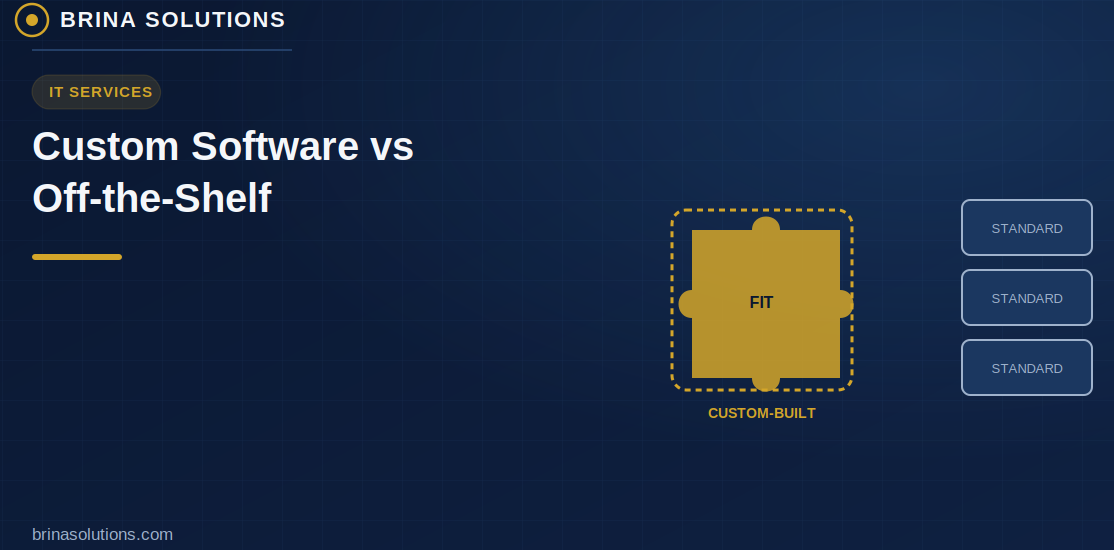
Not every business fits into a one-size-fits-all software package. Choosing between custom software solutions and a ready-made tool comes down to one question: does it actually fit how you work?
Custom Software Solutions: Cost Isn’t the Real Question — Fit Is
Off-the-shelf software is cheaper upfront and faster to deploy. Custom software solutions cost more initially but are built around how your business actually operates, not how a generic template assumes it should. The mistake most businesses make is treating this as purely a budget decision, when it’s really a decision about how much your operations differ from the “average” business the off-the-shelf tool was designed for.
When Off-the-Shelf Software Works Fine
For a large number of businesses, off-the-shelf software is genuinely the right call, not just the cheaper one. It works well when:
- Your processes are fairly standard (accounting, basic CRM, email marketing)
- You need something running within days, not months
- Budget is tight and requirements are simple
- You don’t yet know exactly what you need, and want to learn by using a flexible general tool first
Many businesses successfully run for years on off-the-shelf platforms, only outgrowing them once their processes become distinct enough that the software starts working against them instead of for them.
When Custom Software Solutions Pay Off
Custom software solutions earn back their higher upfront cost when the business has needs a generic tool simply can’t accommodate. Common signals include:
- Your workflow doesn’t map cleanly onto existing tools
- You’re paying for features in a generic package that you never use
- You’ve hit a ceiling where the software is limiting growth, not supporting it
- You’re manually working around the software’s limitations on a daily basis
- Your competitive advantage depends on doing something a standard tool wasn’t built for
In these cases, the cost of staying on the wrong tool — in lost time, workarounds, and missed opportunities — often exceeds the cost of building something purpose-fit.
The Middle Ground: Custom Software Meets Off-the-Shelf
You rarely have to choose one extreme. Many businesses do best with a core off-the-shelf system, customized or extended in the specific areas where their operations are genuinely unique — rather than replacing everything at once. This hybrid approach lets you keep the reliability and lower cost of established software while addressing the one or two processes that make your business different. Review platforms like G2 are useful for comparing off-the-shelf options before committing, while research firms such as Gartner track broader trends in enterprise software adoption.
Questions to Ask Before Choosing Custom Software Solutions
Before committing either way, it helps to answer a few honest questions: How much does this process actually differ from a standard business? What’s the real cost of staying on a workaround for another year? And critically — do you have the internal capacity to maintain custom software once it’s built, or will you need ongoing external support?
Brina Solutions’ IT Services team helps you weigh this decision honestly, including telling you when off-the-shelf is genuinely the smarter choice. Reach out to talk through your options.