
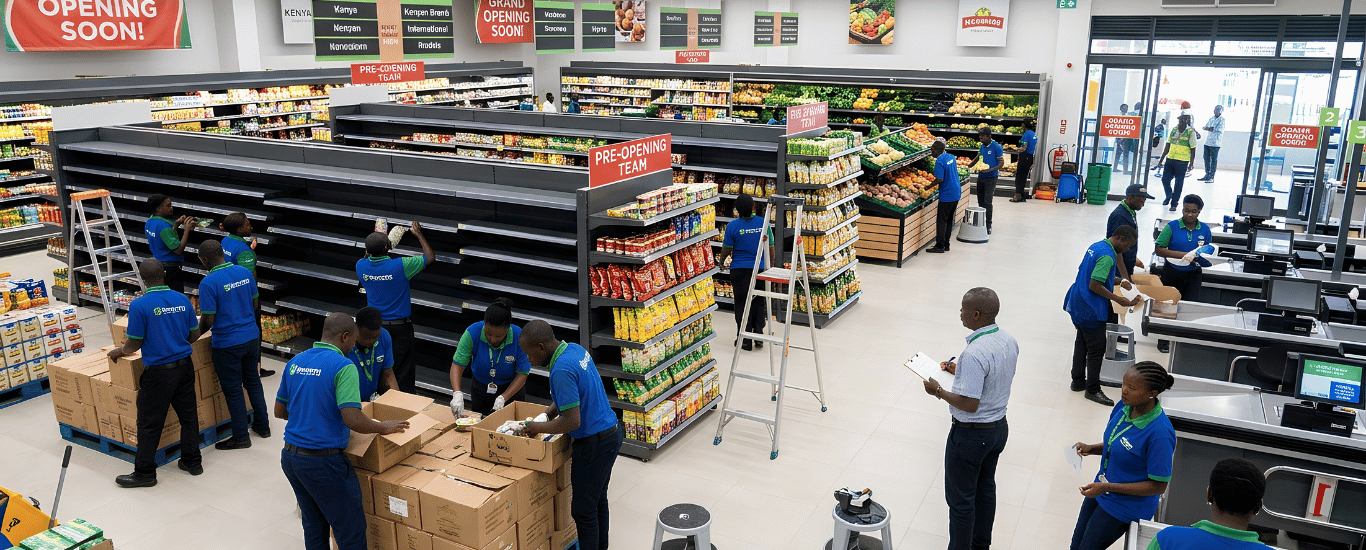
Opening a retail store looks simple from the outside.
You secure a location, install shelves, stock products, hire staff, put up the signage and open the doors.
In reality, a successful retail store opening is a complex project involving procurement, suppliers, merchandising, staffing, technology, compliance, marketing, logistics and customer experience all moving toward one deadline.
And that is exactly why many new retail businesses struggle.
The problem is rarely one major failure. It is usually dozens of small things that were not coordinated properly.
The shelves arrive late.
The POS system is not fully configured.
Key suppliers have not delivered.
Staff have not been properly trained.
Products are on site but not properly priced.
Marketing starts before the store is ready.
Then opening day arrives and the business is forced to improvise.
A professional retail store opening project avoids that chaos by treating the launch as a coordinated project with clear milestones, responsibilities and deadlines.
What Is a Retail Store Opening Project?
A retail store opening project is the coordinated process of preparing a new retail location to begin operating commercially.
It covers everything required to move from an empty or unfinished space to a functioning store capable of serving customers.
Depending on the type and size of the business, this can include:
- Site preparation
- Store layout
- Fixtures and shelving
- Product assortment
- Supplier onboarding
- Procurement
- Inventory planning
- Merchandising
- Pricing
- POS and technology
- Staffing
- Training
- Policies and SOPs
- Branding and signage
- Marketing
- Security
- Cleaning
- Compliance
- Opening-day operations
The critical word is coordination.
Each activity may look independent, but they are connected.
You cannot properly merchandise products that have not arrived.
You cannot train employees on a POS system that has not been configured.
You cannot launch a marketing campaign promising a fully stocked store if procurement is incomplete.
That interconnectedness makes project coordination essential.
Start With the End in Mind
The biggest mistake in a retail opening project is starting with activities instead of outcomes.
Before assigning tasks, define what “ready to open” actually means.
A store should ideally have:
Products available
Systems working
Employees prepared
Suppliers activated
Shelves merchandised
Prices displayed
Store clean
Branding installed
Security operational
Customer journey tested
Marketing activated
Management prepared
This becomes your opening-readiness checklist.
Every activity should ultimately contribute to that outcome.
Build a Retail Opening Master Plan
Don’t manage a store opening through WhatsApp messages and scattered spreadsheets.
Create one master project plan.
A basic structure might look like this:
| Workstream | Key Activities | Responsible Person | Deadline |
|---|---|---|---|
| Site | Construction, cleaning, utilities | Project Lead | Week 1–4 |
| Fixtures | Shelving, counters, displays | Procurement | Week 2–4 |
| Suppliers | Identification and onboarding | Procurement | Week 2–5 |
| Products | Selection and ordering | Buying Team | Week 3–6 |
| Technology | POS, internet, CCTV | IT | Week 4–6 |
| Staffing | Recruitment and onboarding | HR | Week 4–6 |
| Training | SOPs and customer service | Training Lead | Week 6–7 |
| Merchandising | Shelf arrangement and pricing | Retail Team | Week 6–7 |
| Marketing | Pre-opening campaign | Marketing | Week 5–8 |
| Opening | Soft launch and grand opening | Project Lead | Week 8 |
The exact timeline will depend on the size and complexity of the store.
The important thing is that everyone knows what needs to happen, who owns it and when it must be completed.
Appoint One Person to Coordinate Everything
This is one of the most important principles.
A project involving ten departments and twenty suppliers cannot be effectively coordinated if everyone assumes someone else is responsible.
Appoint a project coordinator or project manager.
Their job is to:
- Maintain the master plan
- Track deadlines
- Coordinate suppliers
- Organize meetings
- Identify bottlenecks
- Escalate problems
- Monitor budget
- Track dependencies
- Report progress
- Coordinate opening readiness
This person does not necessarily perform every task.
They make sure every task has an owner.
Work Backward From Opening Day
Suppose the opening date is 1 December.
Don’t start by asking:
“What should we do this week?”
Ask:
“What must be completed by 30 November for us to open successfully?”
Then work backward.
For example:
Opening Day
Store fully operational.
↓
One Week Before
Stock received, shelves merchandised, staff trained, systems tested.
↓
Two Weeks Before
Major procurement completed, suppliers activated, POS configured.
↓
Three Weeks Before
Product selection finalized, staffing substantially complete, marketing campaign underway.
↓
Four–Six Weeks Before
Supplier onboarding, recruitment, fixtures and technology implementation.
This backward planning approach exposes dependencies early.
Supplier Coordination Is a Major Risk
A retail store can have beautiful shelves and still fail to open properly because products are missing.
Supplier onboarding should therefore start early.
Identify:
- Manufacturers
- Distributors
- Wholesalers
- Local suppliers
- Specialized suppliers
Then evaluate:
- Pricing
- Availability
- Delivery capability
- Payment terms
- Minimum orders
- Returns
- Product quality
- Shelf life
For a deeper look at this process, see our guide on Supplier Onboarding for New Supermarkets.
The key lesson is simple:
Do not assume that a supplier who promises delivery will actually be ready when you need them.
Confirm orders.
Confirm dates.
Confirm quantities.
Follow up.
And have alternatives for critical products.
Product Selection Should Happen Before Procurement
Another common mistake is allowing suppliers to determine what the store will stock.
That is backwards.
The store should first define its target market and product strategy.
Ask:
- Who are we serving?
- What does this customer buy?
- What price points matter?
- What brands are expected?
- What products differentiate us?
- What products drive traffic?
- What products provide attractive margins?
Then build the assortment.
After that, identify suppliers capable of supplying it.
This prevents the supermarket from becoming a collection of whatever products suppliers happened to offer.
Don’t Underestimate Merchandising
Once products begin arriving, the next challenge is turning inventory into a shopping experience.
Merchandising involves:
- Category organization
- Shelf allocation
- Product positioning
- Price labels
- Promotional displays
- Product facings
- Cross-merchandising
- Stock rotation
- Signage
The objective isn’t simply to make the store look attractive.
It is to make products easy to find, understand and purchase.
Your supermarket merchandising strategy should therefore be planned before the stock starts arriving.
Technology Must Be Tested Before Opening
Technology failures on opening day are embarrassing and expensive.
Depending on the business, test:
- POS systems
- Barcode scanners
- Payment terminals
- Internet
- Inventory systems
- Receipt printers
- Customer displays
- CCTV
- Access control
- Backup power
- Communication systems
Do not wait until opening morning to discover that your POS cannot process a transaction.
Conduct a full simulation.
Put products through the checkout.
Process different payment methods.
Test returns.
Test discounts.
Test receipt printing.
Test system downtime procedures.
Recruitment Is Not the Same as Readiness
Having employees on the payroll doesn’t mean they are ready.
Retail employees need to understand:
- Their roles
- Store procedures
- Product locations
- Customer service standards
- POS procedures
- Cash handling
- Stock receiving
- Returns
- Complaints
- Escalation procedures
- Safety
- Opening and closing procedures
Training should be practical.
Don’t simply give employees a handbook.
Let them practice.
Run simulations.
Role-play difficult customers.
Practice checkout transactions.
Practice opening and closing the store.
The objective is confidence before customers arrive.
Brina Solutions can support this through Corporate Training, including customer service, sales, communication and team development programs.
Create SOPs Before Opening
Standard Operating Procedures provide consistency.
Your store should have documented procedures for important activities such as:
Opening
Who arrives first?
Who opens the premises?
Who checks security?
Who verifies cash?
Receiving
Who receives deliveries?
Who checks quantities?
Who verifies quality?
Stocking
Who replenishes shelves?
How is stock rotated?
Cash Handling
Who counts cash?
Who authorizes corrections?
Customer Complaints
Who handles escalations?
Closing
Who reconciles sales?
Who secures the store?
SOPs turn individual knowledge into organizational systems.
Marketing Should Start Before the Doors Open
Waiting until opening day to tell customers that your store exists is a mistake.
A strong pre-opening campaign can build awareness and anticipation.
Depending on the store, this can include:
- Social media
- Local advertising
- Community engagement
- Signage
- Digital campaigns
- Influencer partnerships
- Opening offers
- Product previews
- Email or WhatsApp communication
- Roadshows
- Sampling
However, marketing must remain synchronized with operational readiness.
Don’t advertise products you cannot supply.
Don’t promise an opening date you are unlikely to meet.
Marketing should create demand at the same time operations become capable of fulfilling it.
Conduct a Soft Launch Before the Grand Opening
A soft launch is one of the most valuable tools in retail project coordination.
Invite a limited group of customers or operate at controlled capacity before the major launch.
Watch what happens.
Can customers find products?
Are queues forming?
Do employees know what to do?
Are prices correct?
Does the POS work?
Are products scanning correctly?
Are customers asking questions employees cannot answer?
A soft launch exposes problems while they are still manageable.
That is far better than discovering them when hundreds of customers arrive.
The Final 72-Hour Readiness Check
The final days should not be about major construction or unresolved supplier negotiations.
They should be about verification.
Check:
Store
- Cleaning completed
- Lighting working
- Signage installed
- Shelves secure
- Customer areas clear
Products
- Key products available
- Prices displayed
- Stock organized
- Expiry dates checked
- Promotional products positioned
Technology
- POS operational
- Payment systems tested
- Internet working
- CCTV operational
- Backup systems tested
People
- Staff present
- Staff trained
- Roles assigned
- Shift schedules confirmed
- Supervisors identified
Suppliers
- Critical suppliers confirmed
- Outstanding deliveries tracked
- Emergency contacts available
Marketing
- Campaign active
- Opening communication ready
- Promotional materials installed
Management
- Opening procedures tested
- Emergency contacts available
- Escalation process established
If something is still unresolved at this point, it needs an owner and an immediate deadline.
The Biggest Retail Opening Mistakes
Let’s be blunt.
1. Starting Too Late
Retail openings involve too many dependencies to leave everything until the final weeks.
2. No Single Project Owner
When everyone is responsible, nobody is responsible.
3. Buying Too Much Stock
A new store doesn’t need to look full at any cost.
Excess stock ties up cash.
4. Buying Too Little
Empty shelves damage customer confidence.
5. Choosing Suppliers Based Only on Price
Cheap products are useless if the supplier cannot deliver consistently.
6. Ignoring Staff Training
Customers quickly expose unprepared employees.
7. Launching Marketing Too Early
Generating demand before the store is operational creates disappointment.
8. Skipping the Soft Launch
The first real customer should not be your testing environment.
How Brina Solutions Can Coordinate Your Retail Opening
Opening a supermarket or retail store requires multiple disciplines to work together.
That is where Brina Solutions can provide value.
Rather than treating each issue separately, we can help coordinate the major commercial and operational workstreams around the opening.
Our support can include:
- Retail business advisory
- Product selection
- Supplier identification and onboarding
- Commercial coordination
- Shelf planning and merchandising
- Pricing strategy
- Stock planning
- SOP development
- Staff training
- Customer service training
- Marketing and pre-opening activation
- Opening-readiness coordination
This integrated approach is particularly useful for business owners who have the investment and vision but don’t want to personally coordinate dozens of suppliers, employees and service providers.
Our Business Advisory Services can help establish the commercial and operational foundation, while our Marketing Services can support awareness and customer acquisition.
A Successful Opening Is Only the Beginning
Opening the doors is not the finish line.
It is the beginning of the real test.
After opening, management needs to monitor:
- Sales
- Customer traffic
- Average basket size
- Product availability
- Stock turnover
- Gross margins
- Staff performance
- Customer complaints
- Supplier performance
- Marketing results
The first 30, 60 and 90 days should be treated as a learning period.
Use the data to refine your product assortment, merchandising, staffing, promotions and operations.
The store you planned before opening will not necessarily be the store your customers ultimately need.
Listen to the market.
Final Word: Don’t Let Opening Day Become Your Testing Day
A successful retail store opening doesn’t happen because everything magically comes together.
It happens because someone deliberately coordinates the moving parts.
The strongest openings are built around:
Planning.
Accountability.
Supplier coordination.
Product readiness.
Staff capability.
Technology testing.
Merchandising.
Marketing.
And disciplined execution.
If you are preparing to open a supermarket, convenience store, specialty retailer or another retail business, don’t wait until the final weeks to discover what needs to be done.
Start with the end in mind. Build the project plan. Assign ownership. Track every dependency. Test everything. Then open.
Because customers don’t care how complicated your opening project was.
They only see whether the store works.
Opening a Retail Store?
Brina Solutions can help you coordinate the commercial, operational and marketing components required to move from concept to opening day and beyond.
Don’t leave your opening to chance.
👉 Contact Brina Solutions and let’s build a structured retail opening plan around your store, timeline and objectives.