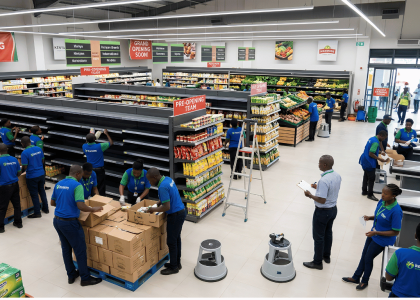

Mastering FMCG Sales: A Comprehensive Guide to Sales Strategy, Team Management and Market Insights
FMCG sales is one of the most demanding areas of business. Products move quickly, competition is intense, customer preferences change, and retailers expect reliable supply. A product can have excellent quality, attractive packaging and competitive pricing, yet still struggle if customers cannot find it when they need it.
In Kenya, this challenge is particularly visible across supermarkets, wholesalers, minimarts, dukas, kiosks, open-air markets and neighbourhood shops. A brand may perform well in Nairobi but struggle to gain traction in Nakuru, Kisumu, Eldoret or Mombasa because distribution, pricing, consumer preferences and retail conditions differ.
Mastering FMCG sales therefore requires more than recruiting sales representatives and setting monthly targets. It involves building a reliable route-to-market strategy, managing distributors, improving retail execution, motivating sales teams and using market insights to make better decisions.
Whether you are managing a growing consumer brand, leading a distribution business or overseeing an established FMCG sales operation, this guide explores the practical strategies that can help you improve sales performance and build a stronger market presence.
1. Understanding the FMCG Sales Environment
Fast-Moving Consumer Goods (FMCG) are products that consumers purchase frequently, usually at relatively affordable prices and with high turnover. They include:
- Food and beverages
- Household cleaning products
- Personal care and hygiene products
- Dairy products
- Packaged foods and snacks
- Toiletries and beauty products
- Everyday household essentials
Unlike products purchased occasionally, FMCG products depend heavily on availability, repeat purchases, distribution efficiency and consistent consumer demand.
Consider a company distributing cooking oil in Kenya. Its success does not depend only on manufacturing a good product. The company must ensure that wholesalers have adequate stock, retailers can reorder easily, sales representatives visit outlets consistently and consumers can identify the product on crowded shelves.
This is where effective FMCG sales management becomes important.
What makes FMCG sales challenging?
Several factors make the sector particularly competitive:
High competition: Consumers often have several alternatives within the same product category. A shopper choosing between different cooking oils, detergents or beverages may switch brands based on price, availability, promotions or personal preference.
Price sensitivity: Household budgets influence purchasing decisions. Consumers may choose smaller packs, affordable alternatives or products offering better perceived value.
Distribution complexity: Products must move through manufacturers, distributors, wholesalers and retailers before reaching consumers.
Short sales cycles: Many FMCG products require frequent replenishment. Delays in ordering or delivery can quickly result in lost sales.
Retail execution: Having stock at a distributor’s warehouse does not guarantee that consumers will find it on the shelf.
An effective FMCG sales strategy must address all these challenges together.
2. Building an Effective FMCG Sales Strategy and Route-to-Market Model
A route-to-market (RTM) strategy defines how a business moves its products from production or supply points to the final consumer. It determines which channels to use, how territories are served, which distributors are involved and how retailers access products.
A weak route-to-market model creates unnecessary distribution costs, inconsistent outlet coverage and missed sales opportunities. A well-designed model improves availability while ensuring that the cost of serving each outlet makes commercial sense.
2.1 Understand where your sales and margins come from
Start by analysing sales performance across different channels, territories, distributors and customer categories.
For example, an FMCG company may sell through:
| Sales channel | Typical customers | Key commercial consideration |
|---|---|---|
| General trade | Dukas, kiosks, neighbourhood shops | Outlet coverage, repeat orders and accessibility |
| Modern trade | Supermarkets and organised retail chains | Listing requirements, shelf visibility and trading terms |
| Wholesale | Wholesalers and bulk buyers | Volume, pricing and stock movement |
| Institutional sales | Hotels, schools, restaurants and organisations | Contract terms, reliability and bulk supply |
| Online channels | E-commerce platforms and direct customers | Convenience, fulfilment and digital visibility |
Do not assume that the channel generating the highest revenue is necessarily the most profitable.
A wholesale customer may place a large order but negotiate a substantial discount. A smaller retailer may purchase less per transaction but generate better margins through frequent repeat orders.
Evaluate each channel using:
- Total sales revenue
- Gross profit and contribution margin
- Distribution and delivery costs
- Average order value
- Frequency of repeat orders
- Credit exposure and payment performance
- Cost of acquiring and servicing customers
The objective is to understand where the business makes money, where it loses money and where additional distribution investment is justified.
2.2 Segment retail outlets and assign the right service model
Not every outlet deserves the same level of attention.
A large supermarket, a busy wholesale shop and a small neighbourhood kiosk have different purchasing patterns, stock requirements and service expectations.
Classify outlets according to their sales potential, location, purchasing frequency, category relevance and strategic importance.
For example:
| Outlet category | Characteristics | Recommended service approach |
|---|---|---|
| High-volume outlets | Strong sales potential and frequent replenishment | Frequent sales visits and dedicated account management |
| Medium-volume outlets | Consistent demand and moderate order sizes | Scheduled field visits and distributor support |
| Low-volume outlets | Smaller orders and lower purchasing frequency | Cost-efficient distributor or van sales model |
| Strategic outlets | Important for visibility, market entry or brand positioning | Relationship management and targeted activation |
This segmentation helps a business allocate sales resources more effectively.
A common mistake is sending representatives to every outlet at the same frequency. This wastes time and money while leaving high-potential outlets underserved.
The better approach is to match the service model to the commercial opportunity.
2.3 Understand primary and secondary sales
One of the most important distinctions in FMCG sales is the difference between primary and secondary sales.
Primary sales refer to products sold by the manufacturer or brand owner to distributors.
Secondary sales refer to products sold by distributors to retailers or other downstream customers.
Some businesses also monitor tertiary sales, which capture movement from retailers to final consumers.
Why does this distinction matter?
Imagine a manufacturer sells 10,000 cartons of beverages to a distributor in one month. On paper, the manufacturer has achieved its primary sales target.
However, if the distributor only sells 4,000 cartons to retailers, the remaining stock may accumulate in the warehouse. The next order could decline, payments may become difficult and the business may face pressure to offer additional discounts.
This is why primary sales should not be treated as the only measure of success.
A strong FMCG sales strategy connects manufacturer-to-distributor sales with actual downstream demand.
Monitor:
- Primary sales volumes
- Secondary sales volumes
- Distributor stock levels
- Retailer order frequency
- Stock ageing
- Product returns and expiries
- Outstanding distributor payments
The goal is to maintain healthy stock movement rather than simply pushing inventory into the distribution channel.
2.4 Design effective territory and beat plans
A beat plan is a structured schedule showing which outlets a sales representative should visit, when they should visit and what they should accomplish during each visit.
Without a proper beat plan, representatives may repeatedly visit familiar outlets while neglecting new or potentially profitable customers.
An effective beat plan should consider:
- Outlet location and geographical proximity
- Sales potential
- Historical order frequency
- Customer replenishment requirements
- Travel distance and transport costs
- Outstanding orders or service issues
- Promotional activities and product launches
For example, a sales representative covering Nairobi’s Eastlands area could have separate routes for Embakasi, Umoja, Kayole and nearby trading centres. The routes should be designed around outlet density, sales potential and practical travel arrangements.
Beat planning should not become a rigid exercise. Managers must review actual performance and adjust routes when demand changes, new outlets emerge or certain territories become less productive.
For additional guidance, see BeatRoute’s guide to FMCG route-to-market management.
3. Improving Retail Execution, Merchandising and Product Availability
A product can be distributed widely and still fail at the point of sale.
Retail execution is where the sales strategy meets the customer. It involves ensuring that products are available, correctly displayed, competitively positioned and easy to purchase.
3.1 Protect shelf presence and product visibility
In a busy supermarket or retail shop, consumers make quick purchasing decisions. If your product is hidden, poorly arranged or unavailable, shoppers may choose a competitor.
Effective merchandising should focus on:
- Correct shelf placement
- Adequate stock availability
- Clear pricing and product information
- Proper arrangement of product variants
- Visibility of promotional materials
- Compliance with agreed display arrangements
- Removal of damaged or expired stock
For example, a detergent brand may have several variants and pack sizes. If only one variant is consistently available, the business could lose customers looking for other options.
Merchandising teams should therefore monitor both product visibility and the availability of the full product range.
3.2 Monitor stock availability and stock-outs
A stock-out occurs when a retailer or distributor does not have the product available when a customer wants to buy it.
Repeated stock-outs can damage brand preference and give competitors an opportunity to gain market share.
Sales representatives should record:
- Products available during each visit
- Products that are out of stock
- Quantities ordered
- Quantities delivered
- Products approaching expiry
- Retailer feedback on demand
The information should be shared with distributors and sales managers so that replenishment decisions are based on actual market conditions.
3.3 Make every sales visit count
A sales representative should not simply walk into a shop, ask what the retailer needs and leave after recording an order.
A productive visit should include:
- Reviewing the retailer’s current stock position.
- Checking which products and variants are selling.
- Identifying stock-outs and replenishment requirements.
- Introducing relevant new products or promotions.
- Addressing complaints and service concerns.
- Confirming the next order or follow-up requirement.
The representative should leave the outlet with a clear outcome, not just a completed visit.
4. Managing and Motivating an Effective FMCG Sales Team
Even the best distribution strategy will struggle without a capable and disciplined sales team.
FMCG sales representatives work in demanding environments. They manage customer relationships, travel between outlets, negotiate orders, respond to complaints and operate under demanding targets.
Sales managers must therefore create an environment where performance expectations are clear, coaching is consistent and incentives reward meaningful results.
4.1 Recruit for practical field capability
Recruitment should go beyond academic qualifications and previous job titles.
A successful FMCG sales representative should demonstrate:
- Strong communication and negotiation skills
- Confidence when approaching new customers
- Ability to build relationships with retailers
- Resilience when dealing with rejection
- Good territory and time management
- Numerical and basic reporting skills
- Integrity and accountability
- Willingness to learn product and market information
During recruitment, use practical scenarios to assess candidates.
For example, ask an applicant how they would convince a retailer to stock a new beverage brand when the shop already carries three competing products.
This reveals more about their selling ability than simply asking whether they consider themselves persuasive.
4.2 Set clear sales targets and performance expectations
Every sales representative should understand what they are expected to achieve.
Targets should be realistic, measurable and connected to the company’s broader commercial objectives.
Useful FMCG sales KPIs include:
| KPI | What it measures | Why it matters |
|---|---|---|
| Sales target achievement | Actual sales compared with target | Measures overall performance |
| Effective call rate | Productive sales calls as a proportion of completed calls | Shows whether visits generate meaningful outcomes |
| Numeric distribution | Proportion of target outlets stocking the product | Measures market coverage |
| Weighted distribution | Share of category sales represented by outlets stocking the product | Shows access to commercially important outlets |
| Lines per call | Number of distinct product lines sold per productive visit | Encourages a broader product mix |
| Average order value | Average value of each customer order | Measures order quality |
| New outlet acquisition | Number of new outlets successfully opened | Tracks market expansion |
| Repeat order rate | Proportion of customers ordering again | Indicates customer retention and product movement |
| Collection performance | Payments collected against amounts due | Supports cash flow and credit control |
| Returns and expiry rate | Value or volume of returned or expired stock | Highlights stock management problems |
Important: Numeric distribution and weighted distribution are not interchangeable. A brand may be stocked in many small outlets but have limited presence in high-volume retailers. Monitoring both provides a better understanding of market reach.
4.3 Design incentives that reward sustainable performance
Sales incentives can improve motivation, but poorly designed commission structures can encourage unhealthy behaviour.
For example, rewarding representatives only for primary sales may encourage them to push excessive stock into distributors. Similarly, paying incentives solely for new outlet acquisition may lead to representatives opening accounts that never place repeat orders.
A balanced incentive structure should consider:
- Sales target achievement
- Secondary sales growth
- New outlet acquisition and retention
- Product range penetration
- Effective call rate
- Collection performance
- Customer service and reporting quality
Avoid rewarding activities that look impressive in a report but do not create lasting commercial value.
A new outlet is only valuable if it is relevant, properly served and capable of generating repeat business.
4.4 Invest in continuous sales training and coaching
Product knowledge alone does not make a strong sales representative.
Field teams need practical skills that help them manage real customer conversations and overcome objections.
Common retailer objections include:
| Retailer objection | How the sales representative should respond |
|---|---|
| “I already stock a competing brand.” | Explain the product’s differentiation and identify a suitable trial opportunity. |
| “Your product is too expensive.” | Explain the value proposition, pack options and relevant customer demand. |
| “There is no shelf space.” | Discuss suitable product placement, stock rotation and realistic opening quantities. |
| “The product does not move.” | Investigate the reasons, review customer feedback and agree on an appropriate corrective action. |
| “I have not received my previous order.” | Verify the delivery issue and coordinate a clear resolution. |
| “I cannot pay now.” | Follow the company’s approved credit and payment procedures. |
Training should include practical role-play, field demonstrations, product knowledge, negotiation, customer relationship management and reporting.
Sales managers should also conduct joint field visits to observe representatives in action and provide specific feedback.
Explore Brina Solutions’ Corporate Training programmes for practical sales, leadership and customer relations development.
5. Using Market Insights to Make Better FMCG Sales Decisions
Market insights help businesses understand what is happening beyond their internal sales reports.
They reveal why certain products are growing, which territories are underperforming, what consumers value and how competitors are positioning themselves.
In a competitive market, decisions based on assumptions can be expensive.
5.1 Understand changing consumer behaviour in Kenya
Kenyan consumers are not one uniform market.
Purchasing behaviour differs by income, location, household size, lifestyle, product category and shopping occasion.
For example:
- A consumer shopping in a neighbourhood kiosk may prioritise affordability and convenient pack sizes.
- A supermarket shopper may compare brands, promotions, product quality and value.
- A wholesale buyer may focus on bulk pricing, margins and stock availability.
- An institutional customer may prioritise consistency, delivery reliability and agreed commercial terms.
Recent research by Kantar highlights how Kenyan shoppers are increasingly seeking value, making more frequent shopping trips and evaluating their choices carefully. Its analysis of Kenyan FMCG shopper behaviour offers useful context for understanding these changes.
The practical lesson is simple: businesses must understand the customer behind the transaction.
5.2 Monitor competitors and market activity
Competitor analysis should be a continuous sales activity, not an exercise conducted only when sales decline.
Field representatives can gather useful information during routine outlet visits.
Monitor:
- Competitor product prices
- Pack sizes and product variants
- Promotional offers
- Shelf placement and visibility
- New product launches
- Retailer preferences
- Distributor coverage
- Customer complaints and product feedback
For instance, if a competing cooking oil brand introduces a smaller, more affordable pack, your sales team should assess whether customers are shifting towards it and whether your own product range meets the same purchasing need.
However, avoid responding to every competitor promotion with a price reduction. The better decision may involve improving availability, strengthening retailer relationships, adjusting pack sizes or communicating product value more effectively.
5.3 Track numeric and weighted distribution
Distribution performance should be measured beyond the number of outlets opened.
Numeric distribution measures the percentage of relevant retail outlets that stock your product.
For example, if a business targets 1,000 outlets and its product is stocked in 400, numeric distribution is 40%.
Weighted distribution measures the proportion of category sales represented by the outlets that stock your product.
A product stocked in a major supermarket chain and several high-volume wholesalers may have stronger weighted distribution than one stocked in many small outlets.
Together, these measures help managers understand both market coverage and the commercial importance of that coverage.
5.4 Use field data to identify opportunities
Sales representatives are often the closest people to the market. They see customer behaviour, competitor activity, stock availability and emerging demand patterns.
Businesses should create simple reporting systems that capture this information consistently.
A useful field report should record:
- Outlet visited
- Products available
- Products ordered
- Competitor activity
- Retailer feedback
- Stock-outs
- Promotional opportunities
- Outstanding issues
- Required follow-up
This information should feed into regular management reviews.
Do not collect data simply to create reports. Every important finding should inform a decision or action.
6. Managing Distributors and Strengthening Trade Relationships
Distributors are critical partners in FMCG sales. They influence product availability, territory coverage, delivery reliability and relationships with retailers.
However, appointing a distributor does not automatically guarantee market penetration.
Businesses need to manage distributor performance and establish clear expectations.
6.1 Select distributors based on capability
A suitable distributor should have:
- Adequate working capital
- Relevant market knowledge
- Appropriate storage facilities
- Reliable delivery capacity
- Established retailer relationships
- Strong financial management
- Capable sales personnel
- Willingness to share sales information
The cheapest distributor is not always the best option. A distributor with poor coverage or weak stock management may cost the manufacturer more through missed sales and damaged market relationships.
6.2 Establish distributor performance agreements
Distributor agreements should define commercial responsibilities and performance expectations.
Important areas include:
- Territory coverage
- Sales targets
- Pricing and margins
- Stock management
- Payment terms
- Reporting requirements
- Product returns
- Promotional support
- Customer service standards
Clear agreements reduce misunderstandings and help both parties understand what successful performance looks like.
6.3 Build relationships beyond transactions
Strong trade relationships are built through reliability.
Retailers and wholesalers are more likely to continue working with suppliers who deliver on time, communicate clearly, resolve complaints and maintain consistent product availability.
Sales representatives should treat retailers as business partners rather than simply sources of orders.
That means understanding their challenges, helping them manage stock and recommending products that match their customers’ needs.
7. FMCG Sales Technology, Reporting and Performance Management
Managing a large sales operation using scattered spreadsheets and informal WhatsApp updates can quickly become difficult.
As a business expands, it needs reliable systems for tracking orders, monitoring field activities, managing distributor relationships and reviewing performance.
Useful technology includes:
Sales Force Automation (SFA): Helps manage sales representative activities, customer visits, orders and field reporting.
Distributor Management Systems (DMS): Provide visibility into distributor orders, stock levels, secondary sales and performance.
Customer Relationship Management (CRM): Helps organise customer information, sales opportunities and relationship management.
Business Intelligence dashboards: Convert sales data into useful reports on territory performance, product movement, outlet coverage and trends.
Technology should solve an actual operational problem. Buying an expensive system without clear processes, trained users and management commitment will not automatically improve sales.
Start by identifying what information management needs, how frequently it is required and who is responsible for acting on it.
8. Testing New Sales Strategies Before Expanding
A strategy that works in one territory may not work everywhere.
Before introducing a new distribution model, pricing structure, sales incentive or promotional campaign nationally, test it in a smaller market.
For example, an FMCG company launching a new personal care product could pilot its distribution strategy in selected Nairobi neighbourhoods before expanding into other counties.
The pilot should have:
- A clearly defined target market.
- Specific sales and distribution objectives.
- Selected outlets and distribution partners.
- A defined budget and resource allocation.
- Measurable performance indicators.
- A review process to assess results.
Evaluate product availability, repeat orders, retailer feedback, sales volumes, distribution costs and profitability.
If the strategy works, refine it before scaling. If it fails, identify the underlying problem rather than repeating the same approach across a larger market.
9. Common FMCG Sales Mistakes Businesses Should Avoid
Even established FMCG businesses can lose opportunities through avoidable management and execution failures.
Focusing only on primary sales: Loading distributors with stock without understanding downstream demand creates inventory pressure and weakens long-term performance.
Ignoring outlet profitability: Serving every outlet in the same way can increase distribution costs without generating enough revenue.
Poor territory management: Unstructured routes lead to missed outlets, unnecessary travel and inconsistent customer service.
Rewarding the wrong behaviours: Incentives based only on order volumes may encourage short-term sales at the expense of repeat business and collections.
Neglecting merchandising: A product that is unavailable or poorly displayed loses opportunities at the point of purchase.
Ignoring market feedback: Sales representatives often identify emerging problems before they appear in monthly reports. Failing to listen to them delays corrective action.
Expanding without testing: Rolling out an unproven sales model across multiple territories can multiply operational problems.
Collecting data without acting on it: Reports have little value when managers do not use the findings to improve decisions.
10. Building a Sustainable FMCG Sales Performance Framework
Mastering FMCG sales requires an integrated approach. Distribution, people, retail execution and market intelligence must work together.
A practical management framework should connect the following areas:
| Performance area | Management priority | Measures of success |
|---|---|---|
| Sales strategy | Channel and territory planning | Revenue, gross margin and sales growth |
| Distribution | Outlet coverage and distributor performance | Numeric and weighted distribution |
| Retail execution | Availability and merchandising | Stock availability, shelf compliance and stock-outs |
| Sales team | Recruitment, coaching and motivation | Target achievement and effective call rate |
| Trade relationships | Retailer and distributor engagement | Repeat orders and customer retention |
| Market intelligence | Competitor and consumer insights | Market coverage and response to opportunities |
| Financial control | Credit, collections and inventory management | Collection performance and stock ageing |
Management should review these areas regularly, identify gaps and assign responsibility for corrective action.
The most effective sales operations do not rely on individual effort alone. They build systems that make good performance repeatable.
Conclusion: FMCG Sales Success Depends on Strategy and Execution
The FMCG market rewards businesses that understand their customers, manage distribution efficiently and execute consistently at the point of sale.
A strong product is only the starting point. Sustainable growth comes from ensuring that the product reaches the right outlets, remains available, attracts consumer attention and generates repeat purchases.
For businesses operating in Kenya, this means understanding the realities of general trade and modern retail, building capable distributor networks, developing disciplined field sales teams and using market intelligence to guide commercial decisions.
Most importantly, businesses must connect their sales strategy to what happens in the market every day.
At Brina Solutions, we believe that growth requires more than a plan. It requires the right strategy, capable people and consistent execution.
Strengthen Your FMCG Sales Strategy with Brina Solutions
Are your sales teams struggling with territory coverage, retailer engagement, product visibility or inconsistent sales performance?
Brina Solutions helps businesses strengthen their route-to-market strategies, improve product activation, develop sales capabilities and build practical systems that support sustainable growth.
Our support includes:
- FMCG Sales Strategy: Strengthening market entry, distribution planning and sales execution.
- Retail Distribution: Improving outlet coverage, distribution coordination and product availability.
- Product Activation: Driving product awareness, trial and consumer engagement through in-store demonstrations, sampling, merchandising and market activations.
- Sales Team Training: Developing practical selling, negotiation, customer relationship and sales management skills.
- Business Advisory: Supporting operational improvement, performance management and business growth.
Activate Demand. Train Teams. Fix Execution.
Let’s discuss how to strengthen your sales operation and take your products further.
Phone: +254 728 624 200
Explore our Marketing Services, Product Activation Services and Corporate Training.
Contact Brina Solutions to discuss your business needs.