If you are a manufacturer in Kenya and your distributor is not pushing your product, here is the cold, hard truth: It is because they do not see enough upside in doing so. In the high-stakes world of Kenyan FMCG (Fast-Moving Consumer Goods), distributors are not your partners in “brand building” they are logistics and cash-flow machines. They prioritize what moves fast, what pays strong margins, what is easy for a tired sales rep to explain, and what already has a line of customers waiting for it.
If your SKU (Stock Keeping Unit) does not tick these boxes, it will sit at the back of the warehouse, gathering dust while the distributor focuses on the “easy wins.” When you ask, “My distributor is not pushing my product; what should I do?”, you aren’t facing a personality clash. You are facing a structural misalignment. You must fix the incentives, fix the demand, or fix the execution system.
1. The Psychology of the Sales Rep: Fix the Incentive Structure First
Sales reps do not push products out of loyalty to your brand or because they like your packaging. They push what helps them hit their targets and put food on their tables.
If your distributor handles “Category Captains” brands from global powerhouses like Coca-Cola, Unilever, or P&G your product is competing for the rep’s mental energy. These global giants have mastered the “Incentive Ladder.” Ask yourself honestly:
- Are your margins competitive enough to make a distributor’s “Key Account Manager” care?
- Do the field reps earn a meaningful, tangible commission on your specific SKU?
- Do you offer “Kitu Kidogo” for the winners volume-based bonuses or quarterly rewards?
If the answer is no, your product is mathematically disadvantaged. Distributors are volume-driven businesses. If they can make more money selling ten crates of a competitor’s product with zero effort than selling one crate of yours with high effort, they will choose the competitor every time. You need to redesign your commercial model to reward performance not just passive listing. If you lack pricing clarity or a robust margin structure, Business Advisory support is essential to re-engineer your profitability so you can afford to be the “favorite” in the distributor’s portfolio.
2. The “Pull” vs. “Push” Delusion: Stop Expecting Distributors to Build Your Market
A fatal mistake many Kenyan manufacturers make is believing that a distributor’s sales team will “build the market” for them. They won’t. A distributor’s job is to fulfill demand, not create it.
When you see brands like Bidco Africa or Brookside Dairy dominating the shelves of local dukas and supermarkets, it isn’t just because their distributors are “hardworking.” It’s because the consumer is already walking into the shop and asking for them by name. This is called “Consumer Pull.”
If retailers and consumers aren’t asking for your product, your distributor has to “push” it which feels like pushing a boulder uphill. You must create the pull yourself through:
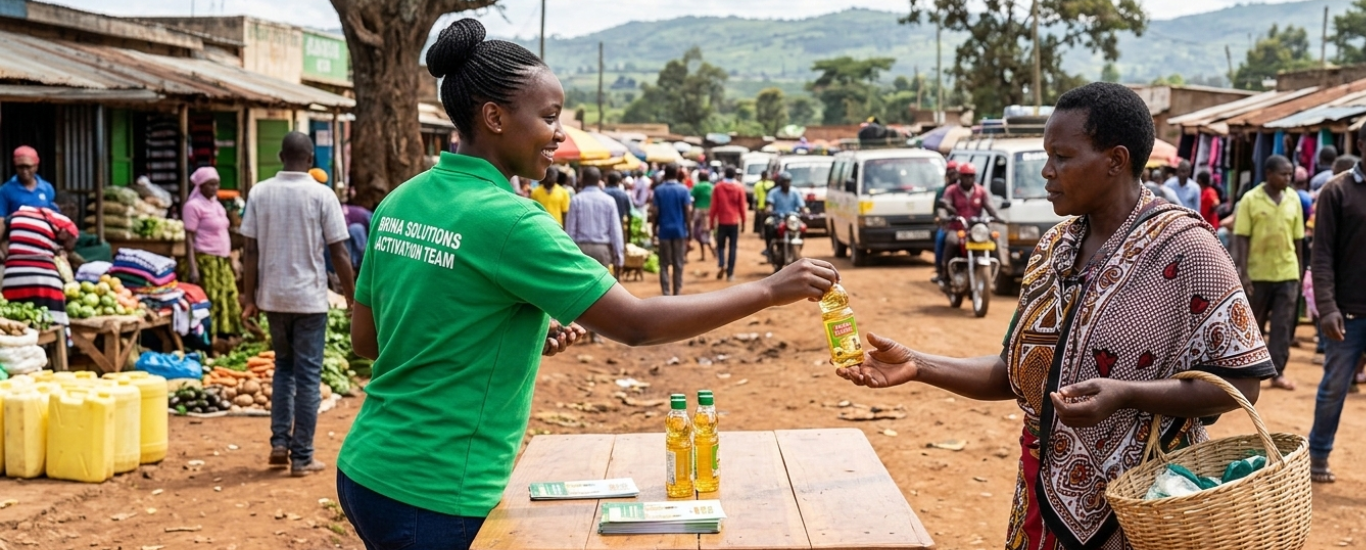
- Product Activation Campaigns: Getting the product into people’s hands.
- In-Store Sampling: Removing the fear of the unknown.
- Aggressive Shopper Education: Explaining why your product is better.
Structured Product Activation services create the momentum that makes a distributor’s job easy. When the market starts pulling, the distributor will naturally push to keep up.
3. Friction is the Silent Sales Killer: Make Your Product “Easy” to Sell
Sometimes the problem isn’t greed or laziness; it’s friction. Imagine a sales rep standing in a crowded wholesale shop in River Road or downtown Mombasa. They have five minutes to take an order before the shopkeeper moves to the next person.
If your product requires a 10-minute scientific explanation of its benefits, the rep will skip it. Global leaders like Nestlé succeed because their products are “self-explanatory.” To win, you must simplify the selling process. Provide your distributor’s team with:
- One-Pager Benefit Sheets: Bullet points on why you win.
- Price Comparison Charts: How you beat the competition on value.
- Trade Bundles: “Buy 5, Get 1 Free” offers that the rep can explain in ten seconds.
Make your SKU the “path of least resistance.” If you make it the easiest option on the truck, it becomes the most sold option on the truck.
4. Trust, but Verify: Monitor Retail Execution Directly
If your product is meant to be in Naivas, Carrefour, or Quickmart, you cannot rely on the distributor’s “word” that the stock is on the shelf. Distributors often focus on “Modern Trade” (large supermarkets) because it’s high volume, but they might neglect the “General Trade” (the thousands of small dukas that make up 70% of Kenyan retail).
You must have your own eyes on the ground. This involves:
- Shelf Audits: Is your product at eye level?
- Stock-Out Monitoring: Is the shelf empty even though the distributor says they delivered?
- Pricing Accuracy: Is the retailer overcharging and killing your velocity?
Professional Retail Distribution oversight ensures that your product doesn’t just “leave the warehouse” but actually “hits the shelf” in the right way. If you aren’t auditing, you are just guessing.
5. The Power of Data: Introduce Accountability and Targets
Distributors respect what you measure. If your expectations are vague (“Please try to sell more this month”), their performance will be vague. You need to transition to a “Performance-Based Partnership.”
Set clear, non-negotiable targets:
- Monthly Volume Targets: By SKU and by region.
- New Outlet Reach: How many new shops did they enter this month?
- Reporting Requirements: Weekly data on sell-in vs. sell-out.
When you bring data to the table, the conversation changes from “You aren’t trying” to “The data shows a 15% drop in Nakuru; let’s fix it.” This level of Go-To-Market strategy ensures that your distribution remains a growth engine, not a source of frustration.
6. Evaluate Territory Coverage: Are They Overstretched?
Often, a manufacturer says “My distributor is failing me,” when the reality is that the distributor is simply overstretched. Kenya is a vast and diverse market. A distributor based in Nairobi might be excellent at covering Kiambu but terrible at reaching Kisumu or Eldoret.
If your route coverage is weak, your sales will be weak. You must analyze:
- Vehicle Fleet: Do they have enough trucks to reach the “last mile”?
- Frequency of Visit: Are they visiting shops once a week or once a month?
- Regional Nuance: Do they understand the local buying habits of the region?
Sometimes, the solution isn’t to “fire” the distributor, but to split the territory and introduce regional partners who have deeper local roots.
7. The Global Lesson: The “Red Bull” Model of Managed Competition
When Red Bull enters a market, they don’t just hand the cans to a distributor and hope for the best. They employ “Musketeers” their own brand experts who work alongside the distributor to ensure the brand is “cool,” visible, and moving.
They use “Controlled Competition.” If a distributor knows they are your only route to market and that you have no way to monitor them, their urgency drops. By introducing performance clauses or splitting territories, you create a healthy sense of urgency. But remember: do not change your distributor until you have fixed your internal strategy. A new distributor will fail just as fast if your product has no demand.
The Verdict: Distribution is a System, Not a Handshake
The brands that dominate the Kenyan landscape the ones that are in every duka from Lodwar to Lunga Lunga understand one thing: Distribution is a managed system. You cannot “set it and forget it.” Increasing sales requires a 360-degree approach:
- Visibility: Can they see it?
- Trial: Have they tasted/used it?
- Incentive: Does the rep make money?
- Consistency: Is it always in stock?
Why Most Manufacturers Struggle
Most SMEs in Kenya fail here because they under-invest in the “Field Force.” They spend millions on a factory but only thousands on a sales strategy. They react to low sales with anger instead of data. They blame the distributor instead of building the brand pull that makes the distributor’s job profitable.
How Brina Solutions Engineers Your Growth
At Brina Solutions, we specialize in the “missing middle” of Kenyan business. We don’t just give advice; we help you implement systems that work in the real world.
- We help you redesign your commercial models so distributors want to sell your product.
- We execute high-impact activation campaigns that create “Consumer Pull.”
- We provide the distribution oversight and data analytics to keep your partners accountable.
Final Word: Move Before the Market Moves Past You
Waiting for your distributor to “try harder” is a recipe for bankruptcy. Every day your product sits stagnant is a day a competitor is winning over your customer. In the Kenyan retail market, the window of opportunity is narrow.
You have two options today:
- Keep hoping that a handshake agreement will eventually turn into a sales miracle.
- Build a data-driven, incentive-aligned system that makes your product the most profitable choice in the warehouse.
Book a strategic consultation with Brina Solutions today. Let’s fix the incentives, build the demand, and turn your distribution channel into a high-velocity growth engine.