
If you’re planning a launch and asking, How to launch a product in Kenya without wasting your marketing budget?, here’s the direct, perhaps uncomfortable, answer: Stop trying to look big. Start trying to convert.
In the Kenyan retail ecosystem, “noise” is expensive and often useless. Most failed product launches in Nairobi, Mombasa, or Kisumu don’t collapse because the product is inherently bad. They fail because the budget is scattered too many billboards on Mombasa Road, too many “micro-influencers” with fake engagement, and too much vanity, with zero ground-level strategy.
A launch is not a party; it is a clinical exercise in controlled demand creation. If you want to survive the first 90 days in outlets like Naivas, Carrefour, or Quickmart, you need to stop burning capital and start building a bridge to the consumer’s shopping basket.
1. The “Ghost Launch” Trap: Validate Before You Announce
The single biggest waste of a marketing budget happens before a single unit even hits the shelf. Many Kenyan manufacturers produce at scale, fill a warehouse, and then try to “market their way out” of a product that nobody actually wants at that price point.
Before you spend a shilling on a radio jingle, you must validate your assumptions. This isn’t just about “asking friends.” It’s about hard data on:
- Price Sensitivity: Will a shopper in Kayole pay the same as a shopper in Kileleshwa?
- Taste/Preference: Does the flavor profile actually suit the Kenyan palate?
- Packaging Perception: Does it look premium, or does it look “cheap” in a way that hurts trust?
Global giants like Safaricom or Coca-Cola never launch blindly. They run silent pilots, gather feedback, and tweak the “Value Proposition” before the big reveal. If you skip this, you aren’t launching; you’re gambling with your company’s future. Market Research and Go-To-Market Strategy are the only insurance policies against expensive guesswork.
2. The Sniper Approach: Define a Narrow Launch Target
Kenya is not one uniform market. One of the fastest ways to go broke is trying to “launch everywhere” at once. If your budget is spread from Turkana to Tenwek, your impact will be so thin that nobody notices you.
Think like Uber or Little Cab. They didn’t launch in every African city on day one. They dominated specific neighborhoods, perfected the model, and then expanded. To protect your budget:
- Start with a “Lead Region”: Dominate a specific cluster of estates or a specific retail chain.
- Master the General Trade: If your product is for the mass market, don’t ignore the duka.
- Control the Momentum: It is better to be “Sold Out” in five stores than “Gathering Dust” in fifty.
3. The “Billboard Illusion”: Activation vs. Awareness
This is the “Black Hole” of marketing budgets. Billboards feel powerful because you can see your own face or product while driving to work. Radio feels visible because your auntie heard the ad. But awareness without Product Activation is just a charity donation to media houses.
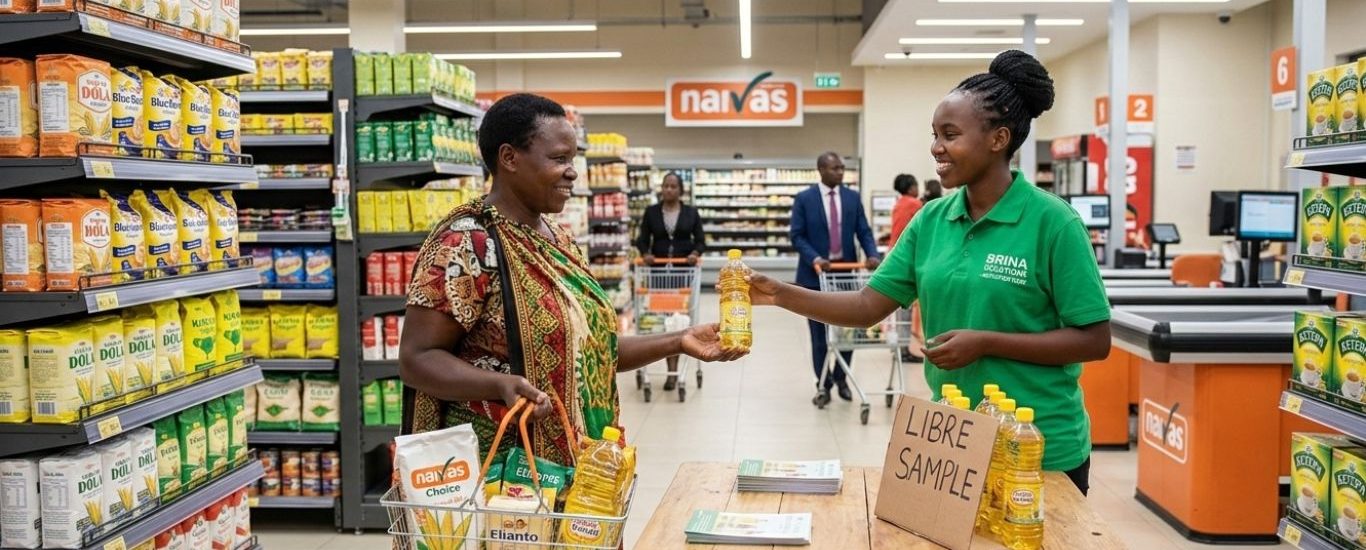
If you want to know how to launch a product in Kenya without wasting your marketing budget, you must flip the ratio. Spend 70% of your budget on things that happen inside or directly outside the store.
- In-Store Sampling: In Kenya, “tasting is believing.”
- Roadshows & Demos: Move the product to the people.
- Shopper Education: Why should they switch from the brand they’ve used for 20 years?
When SunKing expanded solar solutions in East Africa, they didn’t just buy ads; they sat in market centers and showed people how the lights worked. They converted skeptics into customers in real-time. High-impact Product Activation Services turn “maybe” into a sale. Noise is for vanity; conversion is for sanity.
4. Margin Engineering: Pricing for Entry
A launch is not the time to protect “ego margins.” If you enter the market priced 10% higher than the market leader without a massive, obvious reason why, you will fail.
You need “Entry Engineering”:
- Introductory Bundles: “Buy the detergent, get the sponge free.”
- Retailer Incentives: Give the supermarket floor manager a reason to put you at eye level.
- Limited-Time Offers: Create urgency.
If you are struggling to find the balance between “cheap” and “profitable,” professional Business Advisory support can help you map out a pricing ladder that allows for an aggressive launch without eroding your long-term brand equity.
5. The “Silent Listing” Disaster: Secure Retail Visibility
Entering Naivas, Quickmart, or Chandarana Foodplus is only the beginning. If your product is listed but tucked away on the bottom shelf near the floor, your launch is over before it started.
A launch budget must be used to “buy” visibility:
- End-Cap Displays: The shelves at the end of the aisle.
- Cross-Merchandising: Putting your coffee brand next to the milk or sugar.
- Trained Promoters: Human beings who can steer a trolley toward your product.
A launch without visibility is just a “silent listing.” You need a Retail Distribution Strategy that ensures your physical execution on the shelf matches the hype on social media.
6. The 90-Day Rule: A Launch is a Season, Not a Day
Most businesses treat a launch like a wedding one big party, then it’s over. In reality, a launch is a 90-day “Performance Window.”
- Weeks 1-4 (The Spark): Heavy activation, sampling, and securing shelf space.
- Weeks 5-8 (The Echo): Retargeting those who sampled and gathering first-round feedback.
- Weeks 9-12 (The Pivot): Analyzing data which stores are moving? Which regions are dead?
Brands like Unilever don’t “launch and disappear.” They monitor the “velocity” (units per store per week) and double down on what works. Momentum must be sustained, or the retailer will delist you by month four.
7. Vanity Metrics vs. Retail Reality
Do not celebrate “Likes,” “Shares,” or “Impressions.” You cannot pay your staff in “Reach.” To protect your marketing budget, you must measure:
- Trial-to-Repeat Rate: How many people bought it a second time?
- Promotion Lift: How much did sales jump during the activation?
- Retail Compliance: Are your displays still up, or did the supermarket staff take them down?
If you aren’t tracking these, you are flying blind. Waiting for quarterly reports to see if your launch worked is a recipe for bankruptcy. You need weekly, even daily, data.
8. Integrated Strategy: Avoid the “Agency Scramble”
Many launches fail because of fragmentation. One agency does the creative, another handles the influencers, a third handles the roadshow, and the manufacturer handles the retail. The result? A confused message and a wasted budget.
You need a “Command Center” approach. One central strategy that ensures the influencer is saying the same thing the promoter is saying at the Carrefour entrance. Strategic Business Advisory ensures your ROI objectives are the North Star for every cent spent.
9. The Repeat Purchase: The Only Metric That Matters
A launch is only successful if the customer comes back. One-time trial induced by a heavy discount is easy; building a habit is hard.
- Maintain Promotional Rhythm: Don’t stop all marketing on Day 31.
- Listen to the Market: If everyone says the cap is hard to open, fix the cap immediately.
- Reward Loyalty: Make the second and third purchase feel as rewarding as the first.
The Brutal Truth About Kenyan Launches
Most Kenyan product launches fail because the founders were in love with the idea of being a big brand, but they weren’t in love with the grind of retail execution. They spread their budget too thin, ignored the duka, priced themselves out of reality, and hoped that “Digital Marketing” would do the heavy lifting.
Execution discipline is the only thing that protects your budget.
How Brina Solutions Engineers Your Success
At Brina Solutions, we don’t believe in “pretty” marketing that doesn’t sell. We design structured product launches that bridge the gap between your factory and the consumer’s home.
- We validate your market before you burn cash.
- We deploy activation teams that actually move stock.
- We structure retail compliance so you own the shelf.
Final Word; Protect Your Capital. Every launch burns money. The only question is whether that money converts into sustainable sales or evaporates into “awareness.” If you are preparing to launch in Kenya and want to avoid the “90-day delisting” trap, don’t rely on hope.
Book a strategic consultation with Brina Solutions today. Build demand intentionally. Control execution precisely. Launch with a system—not just a budget.